1100, Holy Roman Empire, Servant, (Freese)
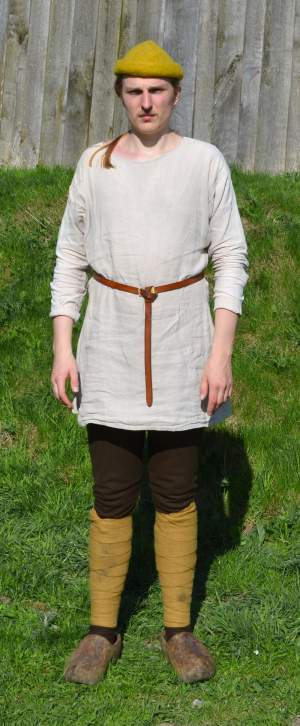
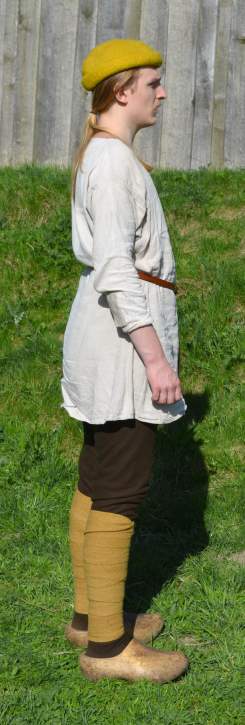
The pictures were taken during the Heydenwall castle training 2018 in Vechta. (2018-04-21)
Summary of the presentation
This is my attempt to depict a servant from the Roman Empire in the period between the last quarter of the 11th century and the first quarter of the 12th century. This is initially reflected by the costume (expand to more material culture later). It includes:
- clothing: upper and lower tunic (tied with a leather belt), bruches and leg warmers (worn with a leather waist belt), calf wraps and cap, as well as leather or wooden shoes depending on the working circumstances.
- Equipment:follows
- Tools: follows
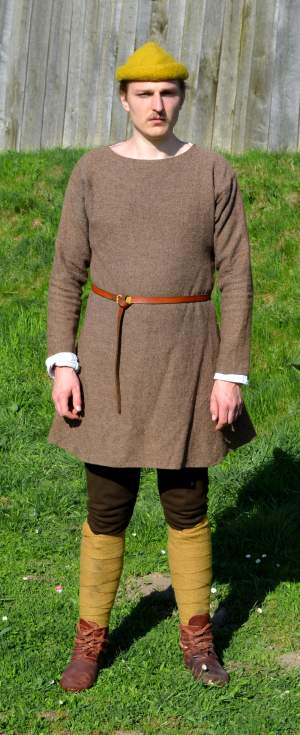
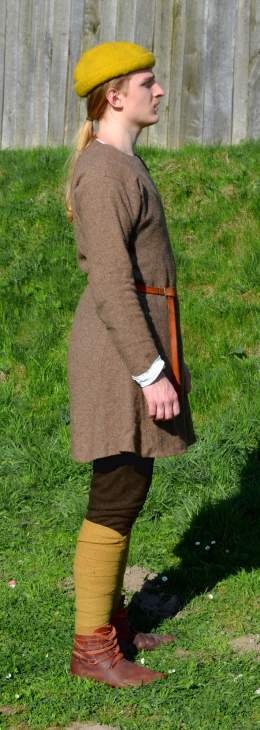
The pictures were taken during the Heydenwall castle training 2018 in Vechta. (2018-04-21)
Explanation of the illustration
A servant is dependent on a master and is not free. Access to luxury goods is therefore correspondingly difficult and possessions must be acquired using the limited resources available. Clothing is made of plain fabrics and at most refined by simple dyeing. To extend their lifespan, they are repaired when necessary. Instead of valuable jewellery, high-quality tools are purchased; like other household goods, these must remain within the scope of local supply as far as possible.
The aim is to focus on the region around Vechta. The regional dispersion of the sources available to me for the period around 1100 and the simplicity of the material goods, which is necessary for a credible representation, create a certain typicity and allow a basic classification in a broader area.
The illustration in detail
Insert image
Breaks
Finding / Cut:
Material: hemp, 1/1 plain weave, semi-bleached.
Notes:
Under tunic
Finding / pattern: Skjoldehamn tunic 1) (early 11th century). Simplifications/modifications: No centre gusset, shoulder seams, round neckline, no trimmings.
Material: Linen, 1/1 plain weave (source: IKEA). Linen yarn.
Notes: The seams (incl. hems) are sewn exclusively in facing stitch. Serging with overlock stitches. The shoulder seam is unsuitable for undergarments (reference Kania!). The pattern is an outer garment.
Tunic
Find / Pattern: Skjoldehamn tunic 2) (early 11th century). Simplifications/modifications: No centre gusset, shoulder seams, round neckline, no trimmings.
Material: Wool. Twill weave (which?). Natural white, natural brown.
Notes: The seams are machine sewn and unfinished. The hems are finished with hem stitches (overlocked).
Leg warmers with footlets
Finding / Cut: Legwarmers of Raimond, Count of Toulouse 3) (ca. 970). The foot section is more orientated towards the leggings from the Bocksten Moor (14th century).
Material: Wool, (weave?) tumbled. Chemically dyed brown. Linen, 1/1 plain weave, natural colour.
Notes: The leg warmers are lined with linen, whereby the lining is only attached to the top of the leg warmers with a stitch. The seam on the back is machine-finished. The seam allowances are overlocked and placed to the respective side.
Calf wrap
Finding / pattern: (insert finding). Ribbon woven to width (9 cm).
Material: Wool, herringbone (source: reeanctors-shop.de). Dyed with tansy (2nd pull).
Notes: End edges folded over and hemmed.
Hat
Finding / pattern:
Material: Wool, felted. Chemically dyed yellow.
Notes:
Belt:
Missing:
A knife
Wooden shoes
Finding / cut: The clogs are modelled on the oldest known clog from Rotterdam (1280-1300).
Material: Poplar wood
Notes: As far as I know, there is no evidence of clogs before the 13th century. In this depiction, however, they are worn as work shoes for practical reasons: sturdy sole/cap, protection against moisture, protection against the cold.
High shoes
Find / Cut: insert image
Material: Leather
Notes: